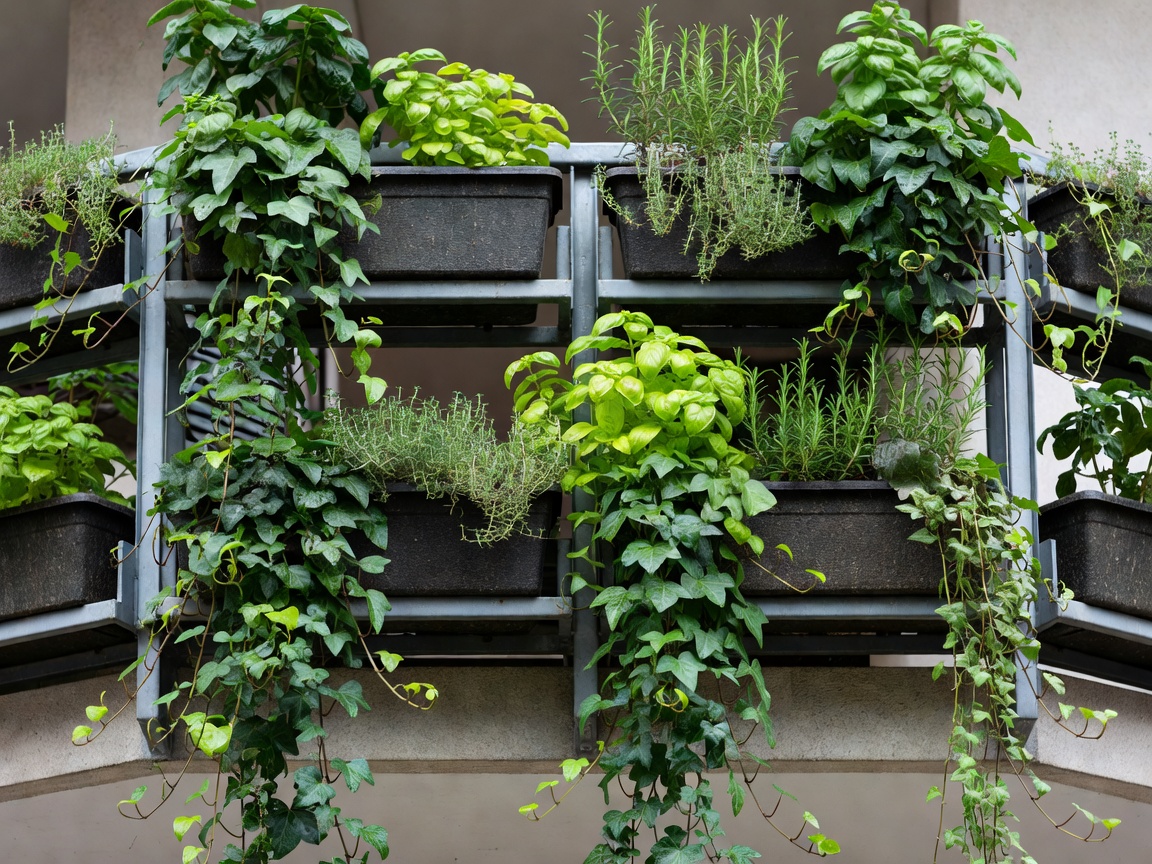
1. Structural Typologies for Urban Green Walls
Vertical gardening on a balcony is not merely hanging flower pots from coat hooks. In high-exposure urban environments, soil drying rates are accelerated by radiant building heat and lateral breezes. Choosing the correct mechanical support is crucial for healthy root growth:
- Rigid Modular Tray Cassettes: Built from UV-stabilized recycled polypropylene, these cassettes feature angled individual cells holding 1.2 to 2.5 litres of substrate each. They click into vertical aluminium mounting rails anchored directly into masonry.
- Felt Pocket Geotextile Panels: Constructed from double-layered non-woven synthetic felt. While lightweight and easy to fold, geotextile pockets require frequent watering because moisture wicks through the exposed fabric surface in warm weather.
- Stainless Steel Cable Trellises: High-tensile 316-grade stainless steel cables spaced 20 to 30 centimetres apart. Instead of mounting root systems vertically, plants are rooted in generous floor trough boxes and trained to climb upward across the wire web.
2. Curating Species for European Micro-Climates
A plant thriving in a damp English garden may perish within three weeks when mounted three storeys up on an unshaded south-facing balcony in Milan. Successful vertical palettes are grouped rigorously by aspect and wind tolerance:
| Solar Exposure | Recommended Species | Foliage Characteristics | Water Demand |
|---|---|---|---|
| South / Full Sun | Rosmarinus officinalis, Lavandula angustifolia, Sedum spurium | Silver-grey, waxy, needle-like; heat-tolerant | Low to Moderate; drought-resilient |
| North / Deep Shade | Polystichum munitum, Heuchera cultivars, Hedera helix | Broad, rich green, textural foliage; shade lovers | Moderate; requires steady moisture |
| East / Morning Sun | Fragaria vesca (Alpine Strawberry), Mentha, Campanula | Tender edible leaves, delicate blossoms | Moderate to High; sensitive to dry soil |
| West / Intense Late Heat | Trachelospermum jasminoides, Santolina, Euphorbia | Resilient evergreen climbing vine; fragrant white bloom | Moderate; hardy against late baking sun |
3. Sub-Irrigation & Capillary Distribution
Hand-watering a three-metre-tall vertical wall with a standard hose or watering can leads to uneven distribution: top cells overflow, while lower pockets receive muddy runoff without absorbing enough deep moisture. The most reliable solution is a closed-loop pressure-regulated drip manifold running across the top row of planters.
Gravity and capillary action pull the water steadily down through successive tiers. By installing a water-retaining geotextile felt pad at the base of each cell, water is held around the root zone without suffocating root respiration or dripping down the exterior facade of the building.
4. Substrates: The Fallacy of Garden Topsoil
Never fill vertical living wall modules with standard field topsoil or heavy peat compost. Over six months, organic peat compost compresses into an impermeable, cement-like block that suffocates root systems and resists re-wetting. Instead, mix a dedicated vertical substrate containing:
- 40% Horticultural Pumice or Perlite: Ensures lifelong structural porosity and prevents compaction.
- 30% Coconut Coir Fibres: Provides biodegradable water retention with superior capillary re-wetting capabilities.
- 20% Composted Pine Bark Fines: Delivers slow-release fungal micronutrients suited to woodland perennials.
- 10% Zeolite or Activated Biochar: Binds trace minerals, preventing rapid fertilizer leaching during watering cycles.
5. Winter Freeze Protection for Suspended Roots
In-ground plants benefit from the thermal mass of the earth, where temperatures rarely drop below freezing 30 centimetres down. Vertical wall modules, however, are exposed to cold air on all sides. During severe sub-zero snaps, the entire root ball can freeze solid in under twelve hours.
For colder continental European zones (USDA hardiness zones 6 to 8a), install a 20 mm extruded polystyrene (XPS) insulation panel directly between the mounting wall and the plant cassettes. This prevents cold masonry from drawing warmth away from the roots. In late autumn, insulate exposed irrigation supply lines with closed-cell elastomeric foam tubing.