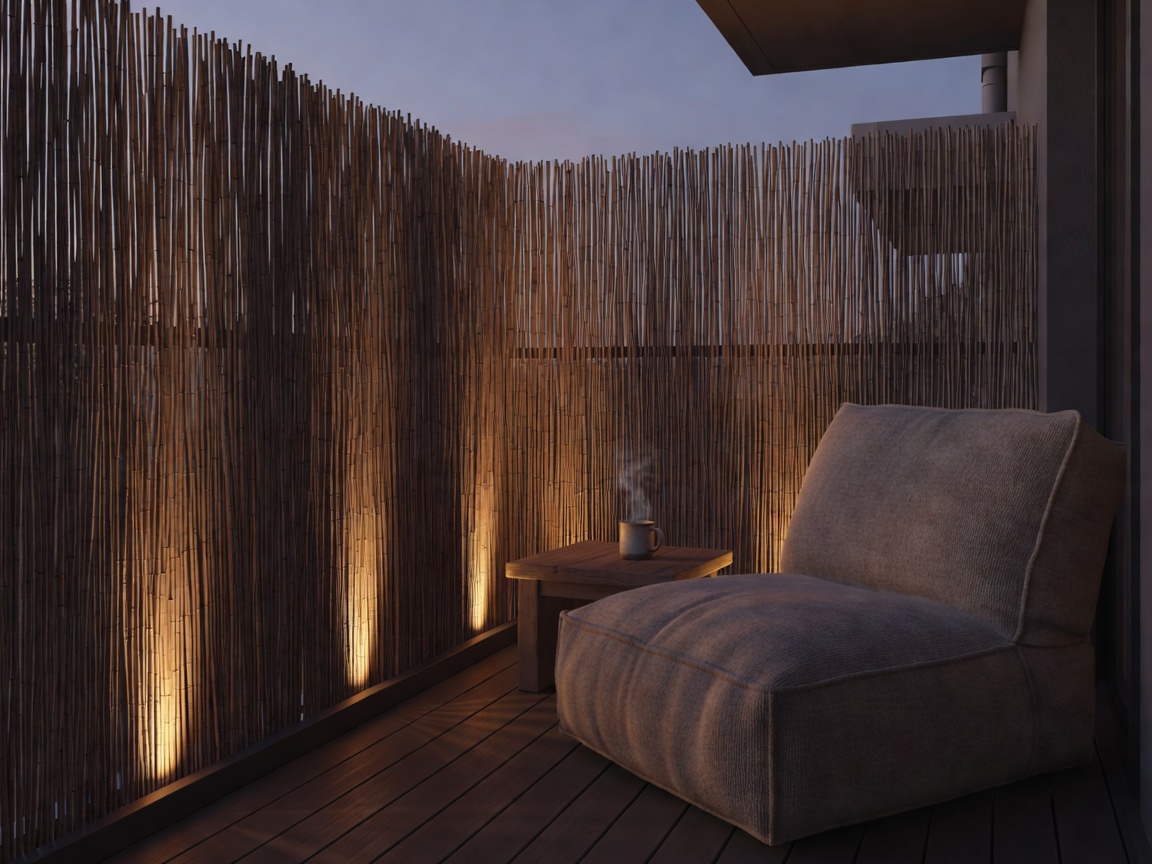
1. Shielding Sightlines Without Claustrophobia
Urban apartment dwellers face a common dilemma: close proximity to across-the-street neighbours or adjoining balconies. Erecting an opaque, heavy wooden partition can run foul of condominium association guidelines and cut off precious natural daylight, turning your interior living room gloomy.
The solution lies in optical translucency. Frosted tempered glass partitions, horizontal batten cedar screens with 20 mm gaps, and woven willow screens obscure direct lines of sight while preserving natural diffuse sunlight. When seated at balcony height, the sightline is completely broken; standing up, peripheral views remain open.
| Screening Solution | Privacy Level | Light Transmission | Wind Permeability |
|---|---|---|---|
| Frosted Tempered Glass (10 mm) | High (silhouette only) | 82% diffuse light | 0% (requires stout structural posts) |
| Western Red Cedar Batten (20 mm gap) | Medium to High at angles | 50% filtered sunlight | 35% (gentle breeze passage) |
| Peeled Bamboo Cane Matting | Medium | 40% natural dappled light | 45% (excellent wind buffer) |
| Solid PVC Tarpaulin | 100% total blackout | 0% (darkens adjoining room) | 0% (prone to wind-induced tearing) |
2. The Three Layers of Evening Illumination
The single most frequent mistake in balcony lighting is mounting a single high-lumen, cool-white floodlight above the balcony door. This produces harsh shadows, creates blinding glare for anyone sitting down, and attracts insects from across the street. Professional botanical lighting relies on three gentle, low-voltage layers:
- Layer 1: Low-Level Perimeter Grazing (100–150 Lumens): Recessed miniature LED deck pucks or water-resistant strip fixtures running under the lip of a bench seat. This casts warm light downward across the flooring, clearly defining physical walking boundaries without shining into eyes.
- Layer 2: Botanical Uplighting (80–120 Lumens): Small 12-volt spotlights placed directly into the root zones of olive trees, structural grasses, or bamboo, pointed upward into the canopy. The rustling leaves cast moving, fluid shadows against walls and balustrades.
- Layer 3: Ambient Eye-Level Accents (40–60 Lumens): Cordless rechargeable table lamps, glass hurricane lanterns with pillar candles, or smoked-glass pendant bulbs suspended under an overhang.
3. Colour Temperature: The Rule of 2700 Kelvin
Never install lighting on an outdoor living balcony above 3000 Kelvin. Blue-tinted white lights (4000K to 6000K) trigger human alertness hormones, undermine relaxation, and clash violently with interior domestic lamps. A warm 2700 Kelvin (or an extra-warm 2200 Kelvin amber spectrum) complements terracotta planters, highlights natural timber grain, and creates an intimate lounge ambiance that encourages deeper rest.
4. Solar Technology vs. Low-Voltage Hardwired Arrays
Budget solar stake lights often disappoint in Northern European winters due to limited daylight hours and overcast skies, generating weak bluish flickers that fade after two hours. High-grade solar luminaires now feature monocrystalline solar panels paired with 18650 lithium iron phosphate (LiFePO4) batteries and intelligent dusk-to-dawn sensors that step brightness down dynamically over four hours.
For dependable, year-round lighting, install a plug-in 12-volt AC step-down transformer connected to an outdoor IP65-rated socket. Low-voltage cables operate at harmless potentials, can be hidden safely under interlocking deck tiles, and power reliable fixtures that illuminate every evening regardless of daily cloud cover.
5. Acoustic Privacy in City Centres
Visual seclusion is only half of the privacy equation; urban street traffic and echoing courtyards also disrupt relaxation. While light screens cannot silence a busy road, natural textures disrupt high-frequency audio reflection. Planting broadleaf evergreens against a textured bamboo or slatted screen scatters ambient sound waves, creating a noticeably softer, more peaceful auditory environment.